
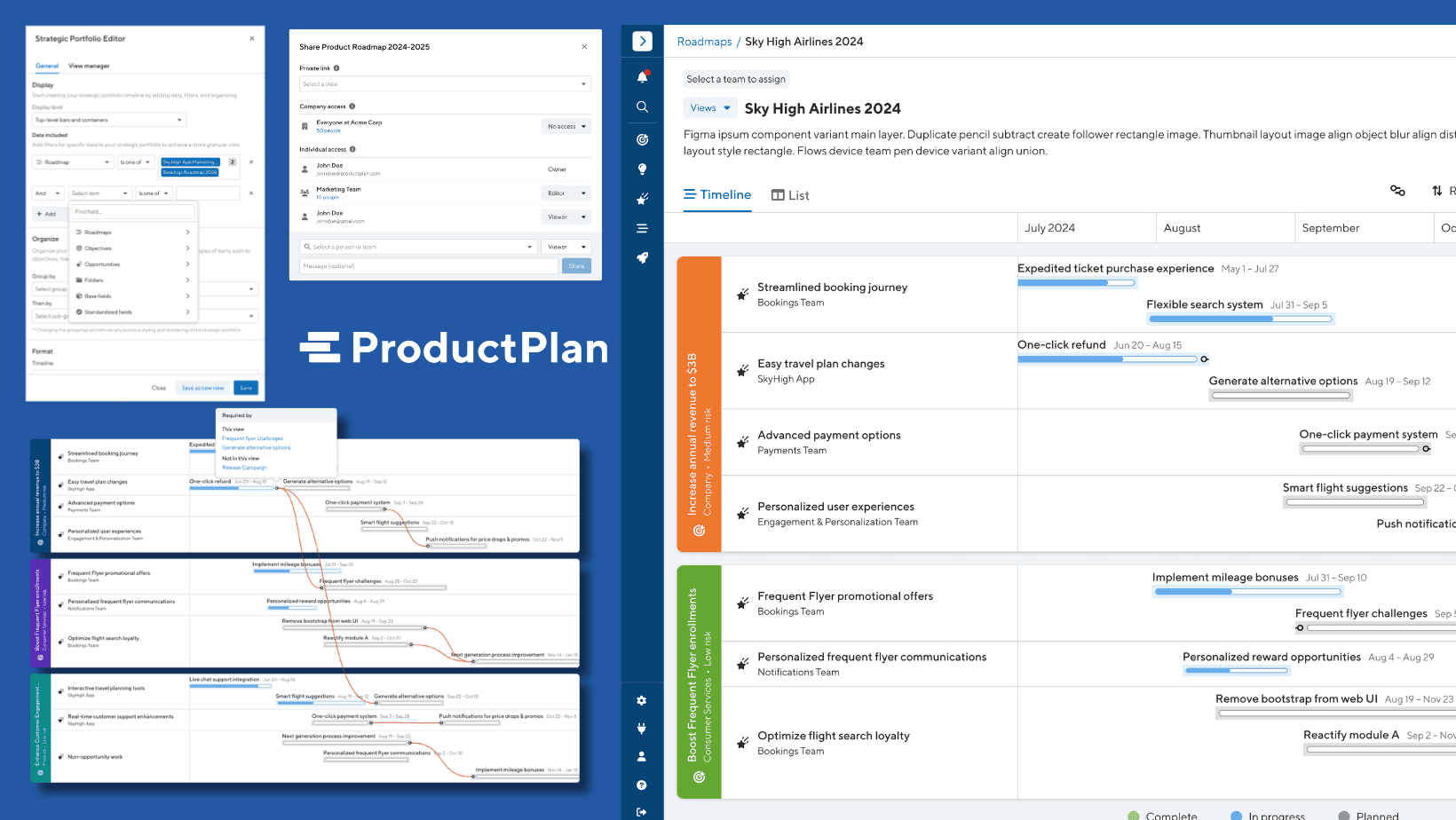
ProductPlan AI Suggested Initiatives
ProductPlan
Closing the Idea-to-Strategy Gap: Designing ProductPlan’s AI-Suggested Initiatives
ProductPlan is a roadmapping and strategic portfolio tool used by enterprise product teams. In late 2024 the company bet on AI to close its idea-to-strategy gap and turn customer input into structured opportunities.
7 months
From Innovation Week prototype to GA release
5
Suggested initiatives returned per prototype run
$150k
ARR from the idea portal work feeding the pipelin
27%
Improvement in user engagement
My Role:
I was the senior product designer on ProductPlan’s AI initiative, working with a product manager and an engineering team. I owned the quantitative discovery, competitive analysis, prototype direction, interaction design, and launch-ready experience.
Constraints:
The hardest constraint surfaced before design started: everything had to run on ProductPlan’s existing stack, with Amazon Bedrock as the only approved model path and explicit user acceptance required before anything reached the roadmap.
ProductPlan AI Suggested Initiatives
ProductPlan
Closing the Idea-to-Strategy Gap: Designing ProductPlan’s AI-Suggested Initiatives
ProductPlan is a roadmapping and strategic portfolio tool used by enterprise product teams. In late 2024 the company bet on AI to close its idea-to-strategy gap and turn customer input into structured opportunities.
7 months
From Innovation Week prototype to GA release
5
Suggested initiatives returned per prototype run
$150k
ARR from the idea portal work feeding the pipelin
27%
Improvement in user engagement
My Role:
I was the senior product designer on ProductPlan’s AI initiative, working with a product manager and an engineering team. I owned the quantitative discovery, competitive analysis, prototype direction, interaction design, and launch-ready experience.
Constraints:
The hardest constraint surfaced before design started: everything had to run on ProductPlan’s existing stack, with Amazon Bedrock as the only approved model path and explicit user acceptance required before anything reached the roadmap.
ProductPlan AI Suggested Initiatives
ProductPlan
Closing the Idea-to-Strategy Gap: Designing ProductPlan’s AI-Suggested Initiatives
ProductPlan is a roadmapping and strategic portfolio tool used by enterprise product teams. In late 2024 the company bet on AI to close its idea-to-strategy gap and turn customer input into structured opportunities.
7 months
From Innovation Week prototype to GA release
5
Suggested initiatives returned per prototype run
$150k
ARR from the idea portal work feeding the pipelin
27%
Improvement in user engagement
My Role:
I was the senior product designer on ProductPlan’s AI initiative, working with a product manager and an engineering team. I owned the quantitative discovery, competitive analysis, prototype direction, interaction design, and launch-ready experience.
Constraints:
The hardest constraint surfaced before design started: everything had to run on ProductPlan’s existing stack, with Amazon Bedrock as the only approved model path and explicit user acceptance required before anything reached the roadmap.
THE PROBLEM
Ideas flowed in; strategy never came out
ProductPlan had an ideas inbox and a roadmap, but the path between them was manual synthesis that rarely happened. Since 2022, customers had attached only 76 ideas to opportunities across the entire platform.
Who it was failing
The primary user was the enterprise product manager: data-driven, cross-functional, and managing hundreds of overlapping idea submissions from sales, support, and customers.
THE PROBLEM
Ideas flowed in; strategy never came out
ProductPlan had an ideas inbox and a roadmap, but the path between them was manual synthesis that rarely happened. Since 2022, customers had attached only 76 ideas to opportunities across the entire platform.
Who it was failing
The primary user was the enterprise product manager: data-driven, cross-functional, and managing hundreds of overlapping idea submissions from sales, support, and customers.
THE PROBLEM
Ideas flowed in; strategy never came out
ProductPlan had an ideas inbox and a roadmap, but the path between them was manual synthesis that rarely happened. Since 2022, customers had attached only 76 ideas to opportunities across the entire platform.
Who it was failing
The primary user was the enterprise product manager: data-driven, cross-functional, and managing hundreds of overlapping idea submissions from sales, support, and customers.
COMPETITIVE LANDSCAPE
Finding the opening: every competitor bolted AI on
I analyzed Zeda.io, Aha!, Productboard, Chisel, Mixpanel, and Pendo in order to find where ProductPlan could differentiate rather than chase. The pattern across all six: AI added to existing surfaces, summarizing feedback or drafting documents, with no understanding of the customer’s strategic context.
COMPETITIVE LANDSCAPE
Finding the opening: every competitor bolted AI on
I analyzed Zeda.io, Aha!, Productboard, Chisel, Mixpanel, and Pendo in order to find where ProductPlan could differentiate rather than chase. The pattern across all six: AI added to existing surfaces, summarizing feedback or drafting documents, with no understanding of the customer’s strategic context.
COMPETITIVE LANDSCAPE
Finding the opening: every competitor bolted AI on
I analyzed Zeda.io, Aha!, Productboard, Chisel, Mixpanel, and Pendo in order to find where ProductPlan could differentiate rather than chase. The pattern across all six: AI added to existing surfaces, summarizing feedback or drafting documents, with no understanding of the customer’s strategic context.
RESEARCH AND DISCOVERY
Validating that the gap was synthesis, not collection
The obvious diagnosis was that idea collection was broken, and my custom fields work had already improved it. The discovery here was quantitative: I queried our production database and Pendo usage data in order to find where the workflow actually stalled.
RESEARCH AND DISCOVERY
Validating that the gap was synthesis, not collection
The obvious diagnosis was that idea collection was broken, and my custom fields work had already improved it. The discovery here was quantitative: I queried our production database and Pendo usage data in order to find where the workflow actually stalled.
RESEARCH AND DISCOVERY
Validating that the gap was synthesis, not collection
The obvious diagnosis was that idea collection was broken, and my custom fields work had already improved it. The discovery here was quantitative: I queried our production database and Pendo usage data in order to find where the workflow actually stalled.
Proving clustering worked against real data
During the company’s AI Innovation Week I partnered with engineers to build a working prototype on Amazon Bedrock in order to test whether clustering was viable with prompt engineering alone. The prototype took a full idea backlog and returned five suggested opportunities per run.
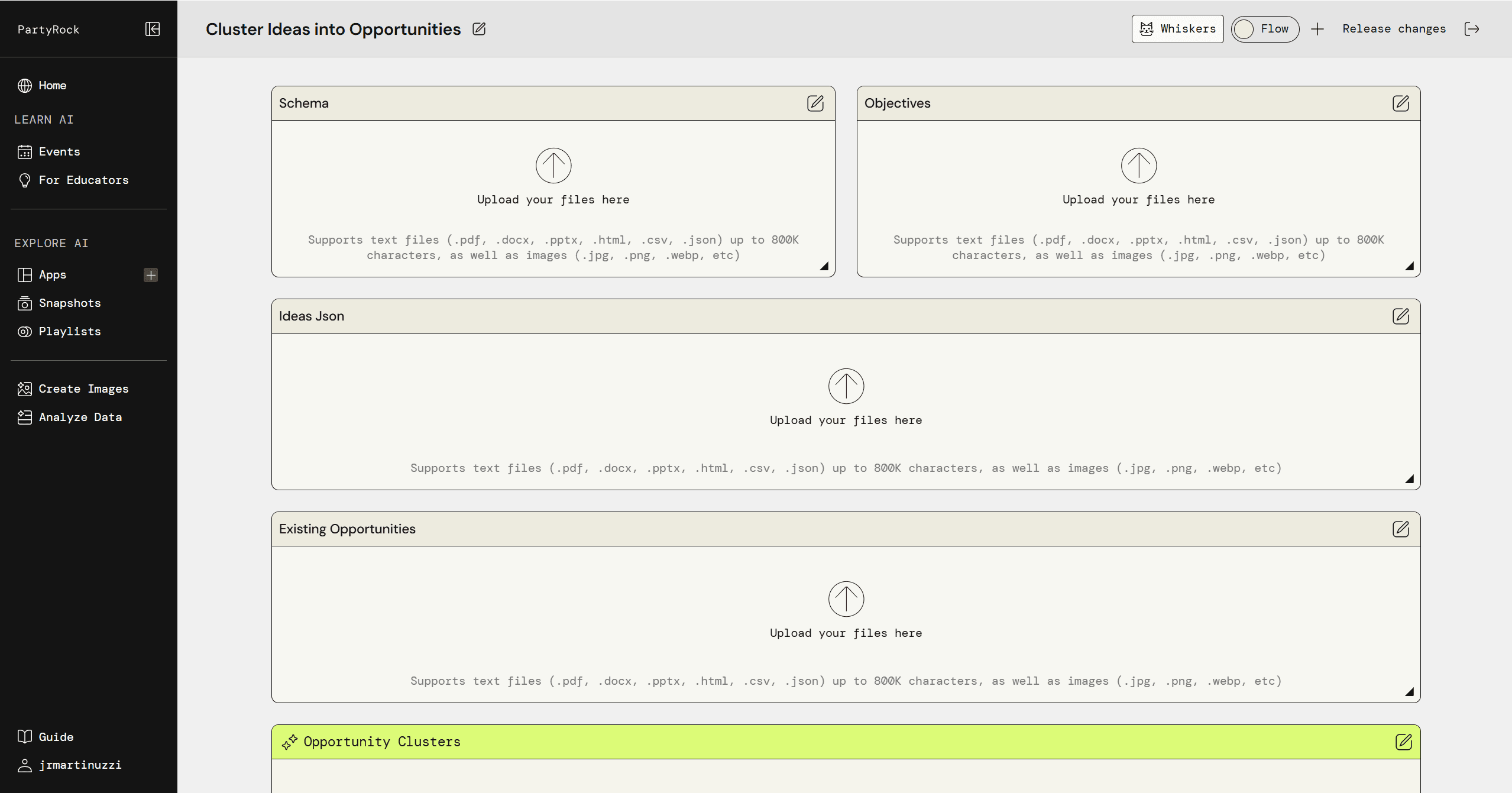
Five suggestions per run, deduplicated against the existing board, so output is reviewable rather than another backlog.
Proving clustering worked against real data
During the company’s AI Innovation Week I partnered with engineers to build a working prototype on Amazon Bedrock in order to test whether clustering was viable with prompt engineering alone. The prototype took a full idea backlog and returned five suggested opportunities per run.
Five suggestions per run, deduplicated against the existing board, so output is reviewable rather than another backlog.
Proving clustering worked against real data
During the company’s AI Innovation Week I partnered with engineers to build a working prototype on Amazon Bedrock in order to test whether clustering was viable with prompt engineering alone. The prototype took a full idea backlog and returned five suggested opportunities per run.
Five suggestions per run, deduplicated against the existing board, so output is reviewable rather than another backlog.
Trust was a top pain point in every segment profile, so nothing touches the roadmap without explicit acceptance.
DESIGN SOLUTION
The hardest call: suggestions PMs own, not automation
The tempting direction was a persistent AI assistant, the pattern Chisel used, available as a context menu across every surface. I rejected it for two reasons: every segment profile flagged trust and transparency in AI-driven decisions as a top pain point, and a floating assistant would be bolted on rather than embedded in the workflow where the synthesis problem lived.
Trust was a top pain point in every segment profile, so nothing touches the roadmap without explicit acceptance.
DESIGN SOLUTION
The hardest call: suggestions PMs own, not automation
The tempting direction was a persistent AI assistant, the pattern Chisel used, available as a context menu across every surface. I rejected it for two reasons: every segment profile flagged trust and transparency in AI-driven decisions as a top pain point, and a floating assistant would be bolted on rather than embedded in the workflow where the synthesis problem lived.
Trust was a top pain point in every segment profile, so nothing touches the roadmap without explicit acceptance.
DESIGN SOLUTION
The hardest call: suggestions PMs own, not automation
The tempting direction was a persistent AI assistant, the pattern Chisel used, available as a context menu across every surface. I rejected it for two reasons: every segment profile flagged trust and transparency in AI-driven decisions as a top pain point, and a floating assistant would be bolted on rather than embedded in the workflow where the synthesis problem lived.
RESEARCH AND DISCOVERY
Designing for the model being wrong
A clustering model is sometimes wrong, and the design had to assume it. Rejection is a first-class action with the same weight as acceptance, so a bad suggestion costs the PM one click instead of eroding trust in the feature. Deduplication against existing opportunities removed the most predictable failure, the model proposing work already on the board.
RESEARCH AND DISCOVERY
Designing for the model being wrong
A clustering model is sometimes wrong, and the design had to assume it. Rejection is a first-class action with the same weight as acceptance, so a bad suggestion costs the PM one click instead of eroding trust in the feature. Deduplication against existing opportunities removed the most predictable failure, the model proposing work already on the board.
RESEARCH AND DISCOVERY
Designing for the model being wrong
A clustering model is sometimes wrong, and the design had to assume it. Rejection is a first-class action with the same weight as acceptance, so a bad suggestion costs the PM one click instead of eroding trust in the feature. Deduplication against existing opportunities removed the most predictable failure, the model proposing work already on the board.
Designing consent before designing features
Trust also needed an account-level surface, not just per-suggestion controls. I designed the AI opt-in experience in account settings in order to give organizations explicit, auditable consent before any AI feature touched their data.
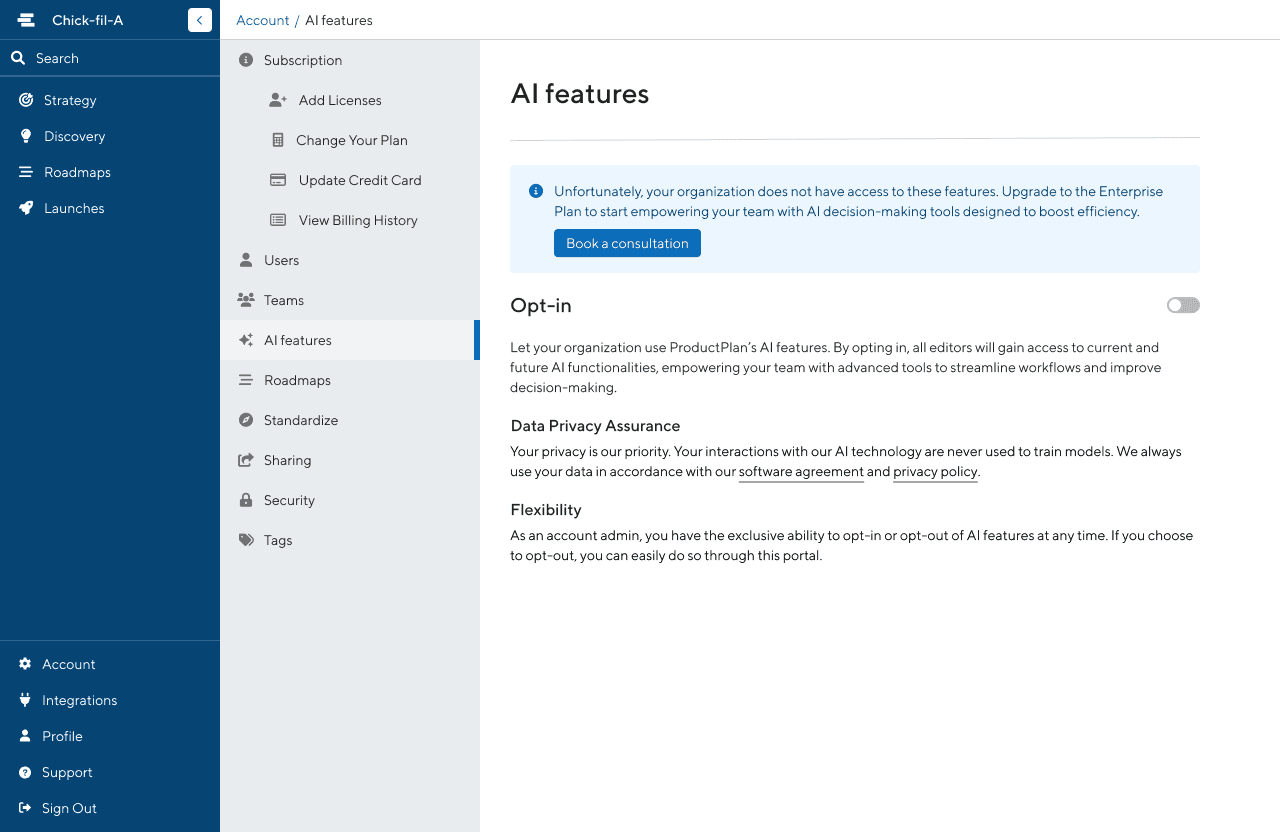
Enterprise trust research demanded auditable consent, so the governance surface was designed alongside the feature, not after it.
Designing consent before designing features
Trust also needed an account-level surface, not just per-suggestion controls. I designed the AI opt-in experience in account settings in order to give organizations explicit, auditable consent before any AI feature touched their data.
Enterprise trust research demanded auditable consent, so the governance surface was designed alongside the feature, not after it.
Designing consent before designing features
Trust also needed an account-level surface, not just per-suggestion controls. I designed the AI opt-in experience in account settings in order to give organizations explicit, auditable consent before any AI feature touched their data.
Enterprise trust research demanded auditable consent, so the governance surface was designed alongside the feature, not after it.
Rebuilding the destination so suggestions had somewhere to land
AI-suggested initiatives are only as useful as the object they create. The legacy Opportunities object held a title and a plain-text description, which is why customers were writing business cases in Confluence instead. I redesigned that object into the Initiative framework, with rich text, customizable templates, stakeholders, status, and custom fields.
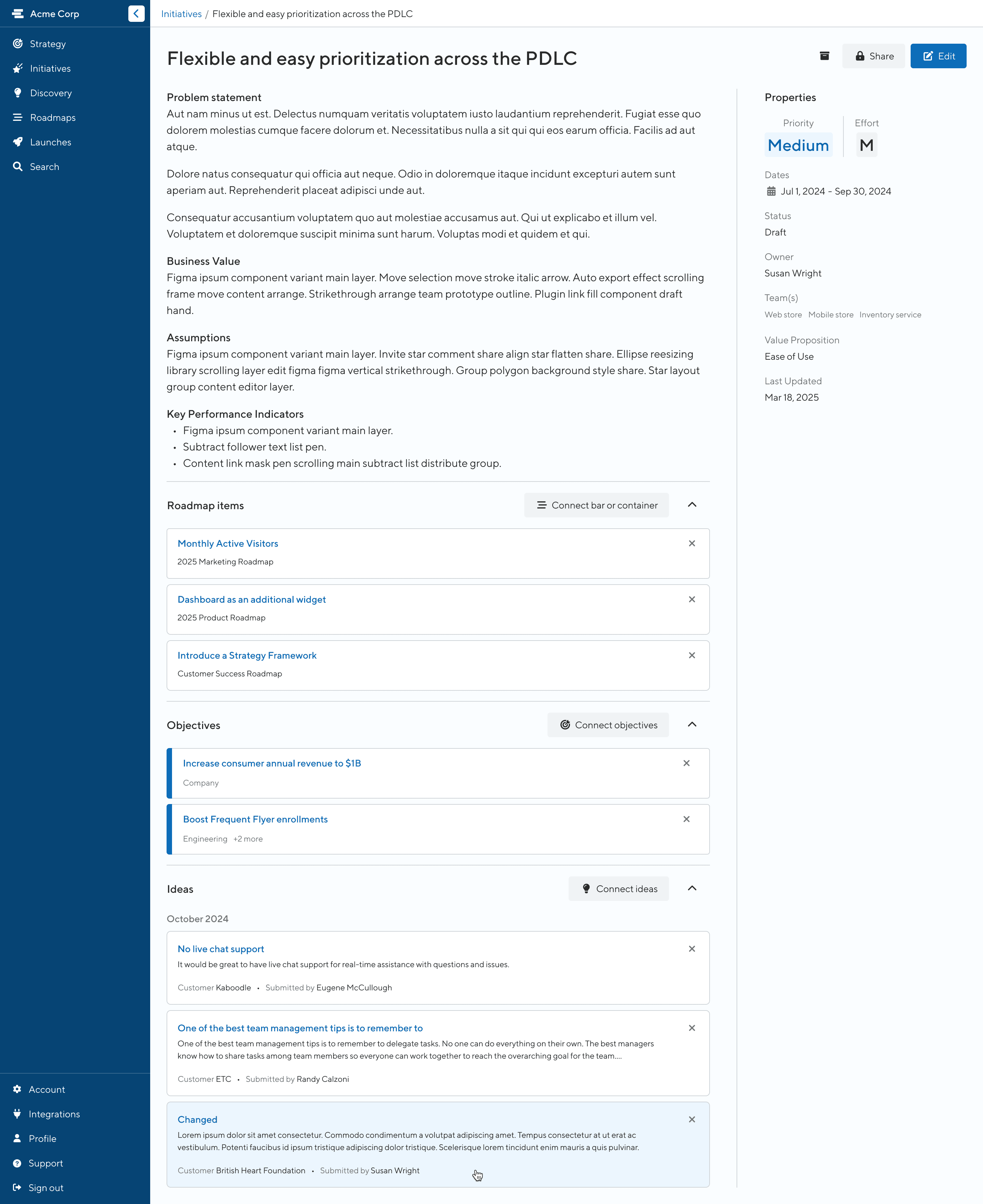
Rebuilt the destination first; AI suggestions into the old object would have automated artifacts nobody used.
Rebuilding the destination so suggestions had somewhere to land
AI-suggested initiatives are only as useful as the object they create. The legacy Opportunities object held a title and a plain-text description, which is why customers were writing business cases in Confluence instead. I redesigned that object into the Initiative framework, with rich text, customizable templates, stakeholders, status, and custom fields.
Rebuilt the destination first; AI suggestions into the old object would have automated artifacts nobody used.
Rebuilding the destination so suggestions had somewhere to land
AI-suggested initiatives are only as useful as the object they create. The legacy Opportunities object held a title and a plain-text description, which is why customers were writing business cases in Confluence instead. I redesigned that object into the Initiative framework, with rich text, customizable templates, stakeholders, status, and custom fields.
Rebuilt the destination first; AI suggestions into the old object would have automated artifacts nobody used.
RETROSPECTIVE
Outcome
The clustering prototype shipped as AI Suggested Initiatives on June 4, 2025, seven months after the Innovation Week prototype. I designed the shipped UI and supported the engineering handoff through the GA release, along with the AI opt-in guardrail.
What I’d do differently
I left ProductPlan in September 2025, three months after GA, before adoption data had time to mature. I would have pushed to instrument suggestion acceptance and edit rates from the first beta, because acceptance rate is the real measure of whether AI suggestions earn trust.
RETROSPECTIVE
Outcome
The clustering prototype shipped as AI Suggested Initiatives on June 4, 2025, seven months after the Innovation Week prototype. I designed the shipped UI and supported the engineering handoff through the GA release, along with the AI opt-in guardrail.
What I’d do differently
I left ProductPlan in September 2025, three months after GA, before adoption data had time to mature. I would have pushed to instrument suggestion acceptance and edit rates from the first beta, because acceptance rate is the real measure of whether AI suggestions earn trust.
RETROSPECTIVE
Outcome
The clustering prototype shipped as AI Suggested Initiatives on June 4, 2025, seven months after the Innovation Week prototype. I designed the shipped UI and supported the engineering handoff through the GA release, along with the AI opt-in guardrail.
What I’d do differently
I left ProductPlan in September 2025, three months after GA, before adoption data had time to mature. I would have pushed to instrument suggestion acceptance and edit rates from the first beta, because acceptance rate is the real measure of whether AI suggestions earn trust.
Featured Case Studies
Featured Case Studies

Bridging the Gap in Strategic Planning with ProductPlan
Driving strategic alignment with 54% month to month retention boost with portfolio visualizations

Curriculum Management for School and District Admins
Increasing Daily Active Usage by 15% through optimization of curriculum management
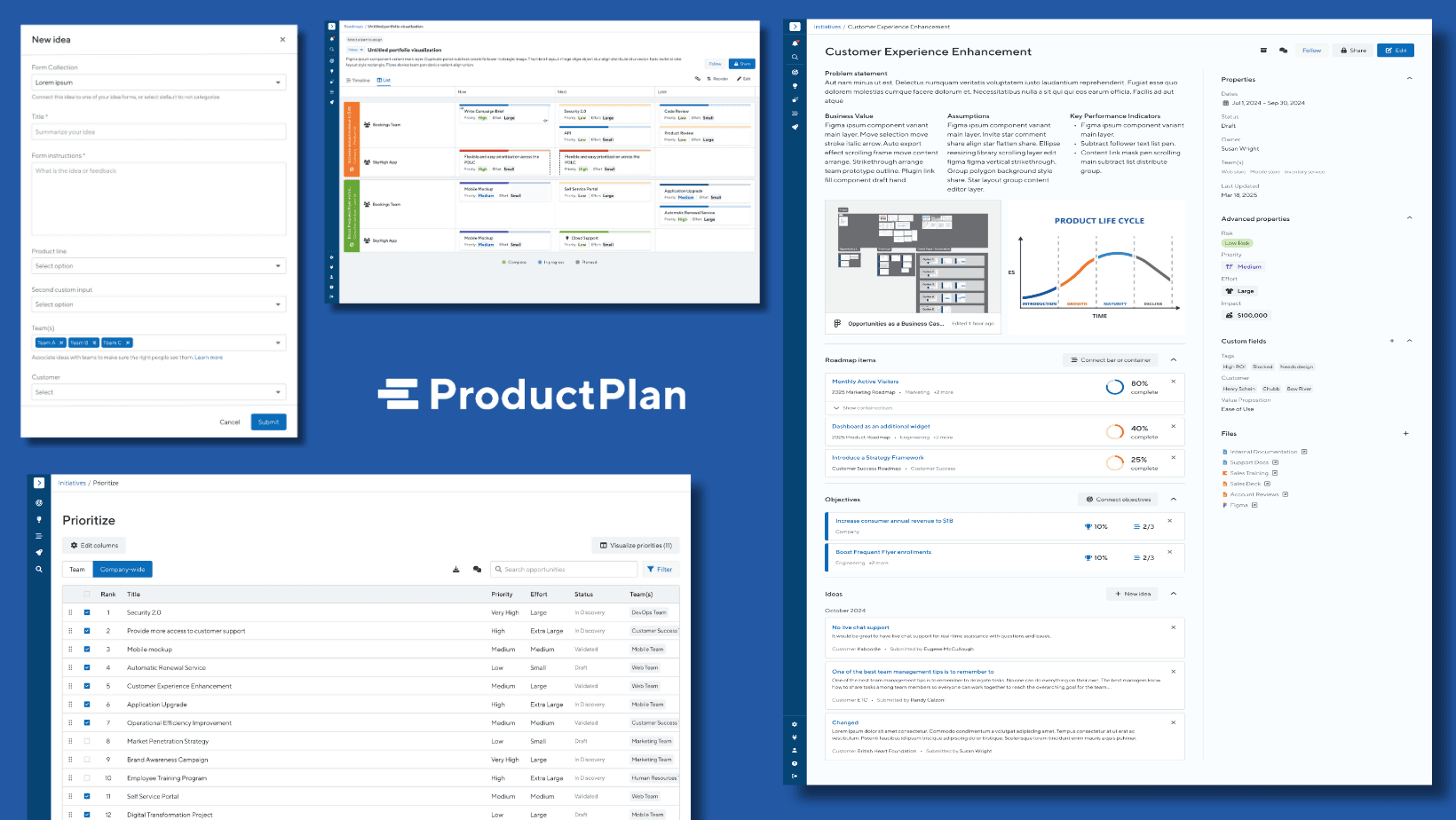
Streamlining Product Development to Reduce Workflow Fragmentation
Achieving a 27% Increase in User Engagement through Streamlined Product Development
Let's build something worth reading about.
Thank you for your interest in my work. Let’s connect!